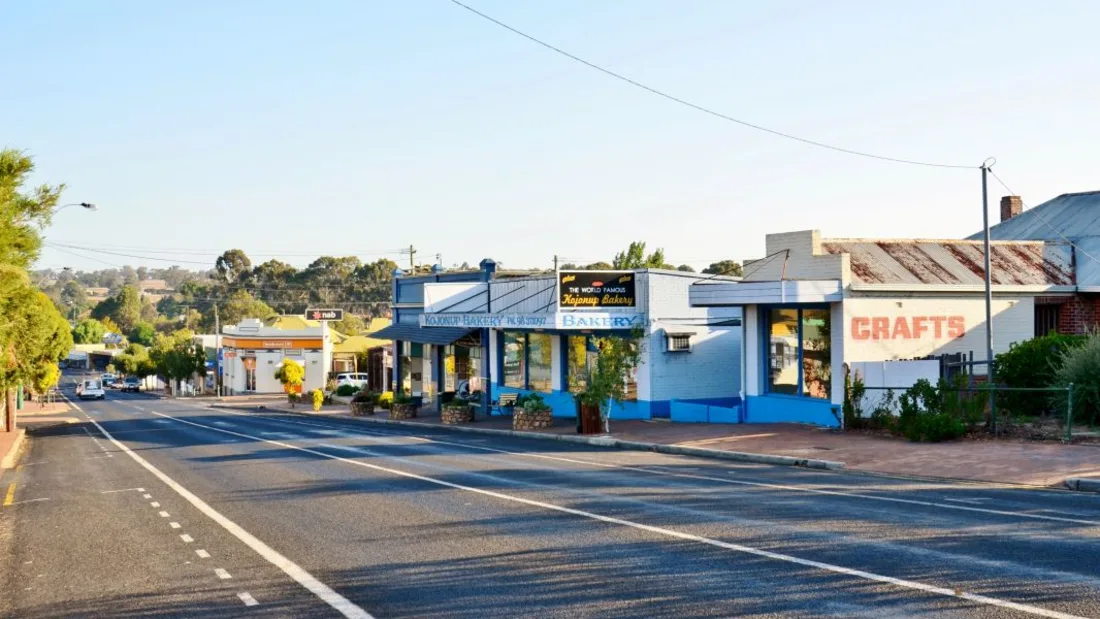
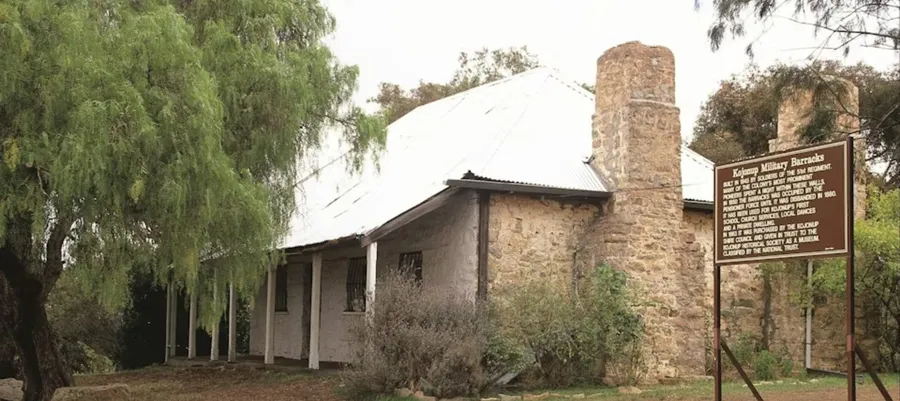
Most people who stop in Kojonup see the Barracks from the road without realising what they are looking at. It sits above the spring on the eastern side of town: a low stone building with thick walls and small windows, and it has been there since 1845.
That makes it the oldest surviving building in the district, and one of the oldest military buildings anywhere in Western Australia. It is also not open on demand, which catches a lot of travellers out. Here is what it is, and how to actually get inside.
Why a military outpost, here?
To understand the Barracks you have to start with the water.
In 1837, a survey party led by Alfred Hillman was guided by Aboriginal people to a freshwater spring in this country, nine years after the Swan River Colony was founded. Reliable fresh water in an inland landscape was the whole game, and Hillman recognised it immediately. The spring is why there is a town here at all.
The land belongs to the Kaniyang people of the Noongar nation, and had drawn people to that water for centuries before any survey party arrived. The name Kojonup reflects that longer history: kodja, the stone axe made by local Aboriginal people from stone found in the area.
Once the inland road between Perth and Albany opened up, the spring became a natural staging point, and an isolated one. Travellers and mail carriers were making a long run with very little along it. The military presence followed the water.
The building itself
A first structure went up in 1837. The building you see today replaced it in 1845, built in stone for soldiers of the British Army's 51st Regiment and positioned to overlook the spring it was there to guard.
Then it did what useful country buildings do, and quietly became other things. Over the following century it served as the district's first school, a meeting place for local church groups, and eventually a private home. That continuous use is a large part of why it survived when so much early colonial building did not.
The Shire bought it in 1963, and the Kojonup Historical Society has run it as a museum since. Its heritage standing is formal: the National Trust classified it on 4 June 1963, and it was added to the Register of the National Estate on 21 March 1978.
How to arrange a visit
This is the part worth planning, because the Barracks is not a turn-up-any-time attraction.
Public access is arranged through the Kojonup Visitor Centre, which sits inside The Kodja Place at 143 Albany Highway. Tours run on Sundays. If you are passing through midweek, or want a look outside the usual window, ring the Visitor Centre ahead rather than arriving and hoping. The grounds are walkable and the building reads well from outside even when it is closed, but the inside is the reason to come.
While you are at the Visitor Centre: it is a recognised Driver Reviver stop, so there is free tea and coffee for drivers, and the staff and volunteers there help with bookings and local information. The Kodja Place also has the Rose Maze, which is a separate thing to see in its own right.
The Barracks sits on the town's historical walk trail, so it pairs naturally with the spring and the rest of Kojonup's heritage on foot. Give yourself an hour if you are taking it seriously.
The spring, five minutes away
Do not drive off without seeing the spring. It is close to the town centre, and it is the reason for everything else in this story: the survey, the barracks, the town, the name.

It is a genuinely unusual thing to stand at. There are not many places in regional Western Australia where the Noongar history of a site and the European history of a site sit in the same small patch of ground, each of them there because of the same water.
Fitting it into an overnight stop
If Kojonup is a break in a longer drive, this is comfortably an evening-and-morning job rather than a whole day. Kojonup is about 250 kilometres from Perth and 160 from Albany, so most people arrive with the afternoon gone and the light going.
Arrive, eat, walk the trail in the morning while it is cool, and be back on the highway by mid-morning if you need to be. If a Sunday tour is the reason you are stopping, build the night before around it.
Where to stay
Cornwall House Accommodation is on the Albany Highway in the centre of Kojonup, a short walk or a very short drive from the Barracks, the spring and the walk trail. There are 12 air-conditioned rooms, each with its own ensuite, free WiFi, tea and coffee, a microwave and a fridge, plus free onsite parking and a shared guest camp kitchen.
Contactless check-in runs from 2pm and late arrivals are no trouble, which matters on a drive where the last hour never goes to plan.
Check availability and book Call us (08) 9831 0214
Frequently asked questions
How old is the Kojonup Old Barracks?
The building standing today was built in 1845, replacing an earlier 1837 structure. It is the oldest surviving building in the district.
Can you go inside the Barracks?
Yes. It is run as a museum by the Kojonup Historical Society, with public access arranged through the Kojonup Visitor Centre and tours on Sundays. Ring ahead if you are travelling midweek.
Why was a military barracks built at Kojonup?
To guard the isolated inland road between Perth and Albany, at a spot chosen for its reliable freshwater spring.
Is the Barracks heritage listed?
Yes. The National Trust classified it on 4 June 1963, and it was added to the Register of the National Estate on 21 March 1978. The Shire of Kojonup bought the building in 1963.